Back to the book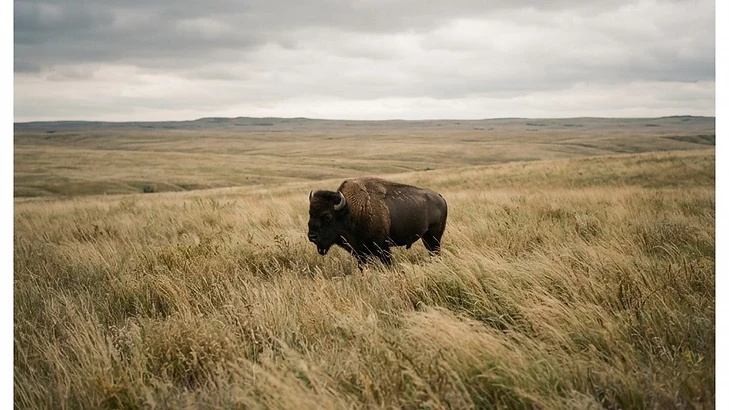
FREE SAMPLE
The opening of Use the Whole Buffalo
A short introduction to Buffalo Mind, Trickster Mind, and one practice for when the sky turns dark fast.
New: The Four Friends Practice Companion — deeper stories, practices, and a 30-Day Return Path. Explore it →
A short introduction to Buffalo Mind, Trickster Mind, and one practice for when the sky turns dark fast.
The buffalo is not a mascot here. It's not a decoration, and it's not a metaphor I borrowed to sound rooted or wise. It comes from a particular relationship to a particular animal, and it carries a particular teaching.
A buffalo stands in weather that other animals run from. It turns its face into the storm, because moving through it, slowly, is how the herd survives. It doesn't pretend the storm isn't real. It doesn't perform calm. It stays on its feet, keeps the herd close, and walks.
There's an older teaching, from people who depended on the buffalo for survival: use the whole animal. Nothing is wasted. The hide, the meat, the bone, the sinew, the marrow. Even the parts that seem hardest to use become part of how the people carry on.
That's the whole instruction for this book. The hard things in your life aren't waste. The grief, the fear, the shame, the conflict, the stories that turn against you. None of it has to be thrown away. The question isn't how to feel less, but how to use what you're already carrying so it stops becoming more harm and starts becoming the path.
I hold this language carefully. The buffalo teaching isn't mine to own, and it isn't here to decorate. It's a way of standing with what's hard that I've found steadier than anything I was taught to perform. If it helps you stand, take it. If it doesn't fit your ground, leave it. That's how this kind of teaching has always moved.
You might have come here in the middle of something. Your chest is tight, your mind is loud, and the ground feels far away. You don't need to read a chapter before you can use anything.
Try this first. It takes about a minute.
That's the whole practice. No special state to reach. You're not trying to become calm. You're letting your body know you're still here before you ask your mind to solve anything.
If that helped even a little, keep reading. If it didn't, that's okay too. Come back when the weather changes.
What if most of what hurts you never actually happened, except in your mind?
Someone's face changes and you don't just see a face; you see rejection. A bill arrives and you don't just see numbers; you see failure. You wake up heavy, and you don't just feel weight; you feel a verdict.
You've been walking around inside a hallucination you call your mind. From sunrise until dark, it throws pictures against the sky of your skull, and you treat every picture as an omen. You call this being "sensitive" or "self-aware." The old teachers would call it sleeping with your eyes open.
This book is about learning how to wake up.
This restless mind that rushes ahead of every moment, that chews on every insult until it tastes like identity, is Trickster Mind.
It's quick, clever, and frightened. It'll invent a storm when the sky is clear because it doesn't know how to rest.
Something small happens:
Before the moment's even finished, Trickster is busy:
Your body believes it. Heart racing. Stomach tight. Jaw locked. The day hasn't really begun, and your nervous system is already on the wrong side of a war.
You say, "I'm just being honest with myself."
No. You're being loyal to Trickster.
There's another mind in you that you've almost forgotten. It doesn't argue. It doesn't decorate. It simply sees.
When a hard word lands, it feels the sting and doesn't build a story around it. When fear rises, it doesn't pretend to be brave; it stands and lets the fear move through. When shame comes, it doesn't bow its head and call the shame "me." It watches, like an old buffalo watching weather roll over the prairie.
This is Buffalo Mind.
You say, "I can't find that mind."
That's not true. You find it every time you stop in the middle of your panic and feel your own weight on the earth. You find it when you listen more than you speak. You find it in the quiet right after you finally tell the truth.
The trouble isn't that Buffalo Mind's absent. The trouble is that you're loyal to Trickster. You defend your stories more fiercely than you defend your life. Someone tries to help you loosen your grip, and you protect the very thoughts that are burning you. You say, "This is just who I am." You mistake the cage for the person.
Nobody wakes up one morning with a steady mind, a calm nervous system, and a wise answer for every hard thing. Not you. Not me. Not Buffalo.
Before Buffalo learned to stand in hard weather, Buffalo ran. When the sky darkened, Buffalo ran. When a sound came from the long grass, Buffalo ran. When another animal looked sideways, Buffalo's mind filled in the rest of the story and ran ahead of what was actually happening.
That's not because Buffalo was weak. It's because fear is quick. Fear hears one twig snap and builds a whole wolf out of it. Fear feels one hard feeling and calls it a life sentence. Fear takes one cloud and says, "That's it. The whole sky is gone."
That's Trickster Mind.
But Buffalo had friends. Not gurus. Not a program. Not a neat little system Buffalo could master and put on a shelf. Friends: the kind who show up in ordinary places and keep telling you something simple until you finally hear it.
Frog was one of the first. Frog lived low to the ground, close to mud and creek water and the small wet places most animals stepped over without noticing. Frog knew what it was to make a sound from a small body. Frog knew a throat could close when fear came near. So when Buffalo's chest tightened and the mind started pulling every old alarm in the field, Frog said, "Breathe first. You don't have to solve the storm before you breathe."
Tree was there too. Tree had stood through more weather than Buffalo could imagine: wind that stripped branches bare, summer heat that cracked the ground, and snow piled heavy on every limb. Tree didn't stand because nothing ever happened. Tree stood because roots had learned where to go. When Buffalo wanted to bolt, disappear, or run toward some imagined better field where nothing hurt and nobody expected anything, Tree said, "Feel your weight. The ground is already holding some of this."
Then Eagle passed overhead. Eagle didn't tell Buffalo the storm was nothing. Eagle didn't say, "Cheer up," or "Think better thoughts," or any of the other useless things frightened minds say when they want pain to leave the room quickly. Eagle circled once and said, "Look again. That cloud is dark, but it isn't the whole sky."
That was the beginning.
Frog taught Buffalo to come back inside the ribs. Tree taught Buffalo to come back to the ground. Eagle taught Buffalo to come back to a wider view.
Buffalo practiced. Not once in a beautiful clearing with nowhere to be. In parking lots. In bad meetings. In the kitchen, with dishes waiting. On sidewalks. In the middle of the night. On days when the mind was loud and the body already felt halfway into a stampede.
A longer exhale. Both feet on the ground. One honest question. Again. And again. And again.
That's how Buffalo Mind grew. Not by becoming fearless. Not by becoming spiritually impressive. Not by getting rid of Trickster Mind forever. Trickster is clever. It'll keep showing up with a fresh theory about why you're doomed, behind, unlovable, secretly broken, or one bad email away from disaster.
Buffalo Mind remembers there's another way to meet the moment.
Breathe. Feel the ground. Look up. Then ask, "What now?"
That's not a complete answer to life. It's enough to get you through the next ten minutes without making the whole field harder to cross.
In the old stories, people went out to fast, to seek a vision, to meet their own fear on the land. You don't need to leave the house. Your own mind is wide enough and wild enough.
You keep waiting for the right retreat, the right teacher, the right week off, the right moment to begin. Meanwhile, Trickster is using your ordinary days as target practice.
Every day, you're given the same simple choice:
Believe Trickster or stand as Buffalo.
Believe the voice that says, "You're not enough, you're alone, nothing will change," and you'll walk in small circles until the body gives out. Stand as Buffalo, silent, heavy-boned, honest, and the same life starts to open in a different direction, step by patient step.
This isn't poetry. It's instruction.
The first training is ruthless kindness with yourself: to see that most of your suffering is self-made and to stop calling it fate.
The second training is to notice, again and again, who's talking right now. Not once a year. Not just on the big days. In the kitchen. In the car. In the grocery line. In the middle of the night. Who's talking right now?
One mind wants drama. One mind wants truth.
You've followed drama long enough.
Before you go on to the next chapter, try this. Think of something that's bothering you today. Nothing huge. Just enough to feel in your body. Now listen.
One voice is telling you what this means about you. It's replaying old hurts, tightening your chest, and writing dramatic titles for what's happening: "Here we go again," "This proves it," "Of course it's me."
That's Trickster Mind.
Another voice is quieter. It's willing to say what happened, feel what's here, and ask, "Okay, what now?"
That's Buffalo Mind.
You don't have to fix anything yet. You just need to know which voice you're about to believe.
If you can't tell them apart, Trickster will keep running your life and calling it "truth."
Use this today.
You're not trying to be wise. You're just taking one small step toward truth instead of drama.
This whole book rests on one fact:
You don't get to choose everything that happens, but you can train which mind responds.
If you're not clear about Trickster and Buffalo, every teaching that follows just turns into another outfit for Trickster to show off in. If you're clear, even a small practice can turn an ordinary day into ground for Buffalo Mind to stand on.
Four simple truths can help with that: reminders that cut through Trickster's nonsense and give Buffalo something solid to lean against when the weather changes.
The book is on its way. Until then, you can find a small practice for the weather you're in, or ask Buffalo Mind for one honest next step.